Up close and personal; a checklist for assessing an investment property in person: Stephen Zamykal
Up close and personal; a checklist for assessing an investment property in person: Stephen Zamykal

So you’ve identified a few properties in your target area that tick all the boxes in your internet search. Now it’s time to check them out in person.
Once you get serious about your property search I recommend making notes on each property so, when you are following up later, you know exactly which property you mean. The simplest way to do this is by creating a checklist and taking additional notes as you go. If you don’t feel comfortable walking through properties armed with a clipboard, you can always make your notes when you are back in your car.
Your checklist could comprise a simple scorecard (out of 10) that covers the following.
Area and position: Distance to the CBD, access to the CBD (public transport), historical growth, shops, parks, street, neighbours, traffic, views
Land: Zoning, size, frontage, privacy, slope, orientation, fencing, car access
Building – exterior: Street appeal, dwelling type (house, townhouse, unit), construction materials (brick, fibro cement, weatherboard), position on the block (front, back, close to the road), number in the block (if a unit), noise, car accommodation, shed/workshop, shape, condition, security
Building – interior: Size and position of all the rooms, quality of appliances in kitchen, air-conditioning (heating and cooling), number of bathrooms, built-in robes/storage, ceiling height, natural light, general appeal/feel
As well as marking features out of 10 it also important that you weight your criteria. For example, the doors might not be very secure but that is not as important as its street appeal – you can always install deadbolts later.
National Property Buyers, a company I am a partner in, uses a score card to rate potential investment properties for clients. Our buyer advocacy business has a strict 58 point criteria & assessment checklist that ranks all 58 segments that need to be ticked off before we will buy a certain property. See in Table 7.3 just 10 of the 58 items we assess on every property that we look at.
Table 7.3 – National Property Buyers – here are 10 of 58 items we assess on every property:
Item No | Items to Assess |
1 | Floor plan and layout |
2 | Street Presence |
3 | Security |
4 | Noise & Privacy |
5 | Car Accomodation |
6 | Proximity to Transport / Shops / CBD |
7 | Position on the Block |
8 | Scarcity Factor |
9 | Size of Bedrooms |
10 | Ceiling Heights |
I hear stories every day about some of the poor property buying decisions people make and my heart opens up to these people. Some people buy without any real criteria or checklist to make sure their money grows at the best possible rate. Without knowledge of the game, unfortunately some people make uneducated decisions based on emotion, which is fraught with danger.
I had a case recently where a mortgage client rang me and said he’d lost $70,000 on a property he’d bought 18 months before. If he’d done his homework properly (or got some professional guidance) he would never have bought that property. The suburb he chose was simply not right for growth. Had he bought better he could have made $150,000 in the same time period – as did two other clients of mine who purchased properties around the same time, although both of these properties were around 20 kilometres away, in a far better location for investment.
Often, when you have a poor investment property in your portfolio, it pays to cut your losses and sell the property. Use the money to invest somewhere that, in the long term, will deliver far better results. I actually did this myself with expert property advice back in the early 2000s. I had a property that was not performing so I sold it, and used a buyer advocate to buy myself a property that ticked all the right boxes. There are buyer advocacy companies like National Property Buyers all over Australia that will analyse your portfolio at no charge.
Asking questions
After you’ve completed an inspection, have a chat to the agent to see what they have to say about the property. Why is the vendor selling? How long has it been on the market? When was it sold the last time and for how much? If it’s currently rented you’ll want to know what the rent is currently set at.
The agent will no doubt ask about you as well. It is fine to tell them what kind of property you’re looking for – they may have some other suggestions – but it’s probably better to not reveal too much detail. Saying something like ‘a period house in good condition close to shops and public transport’ would suffice.
Giving them a price range will help identify properties in your scope but don’t give away too much information because, if they know you have $600,000 to spend, for example, they might use that to their advantage in negotiations.
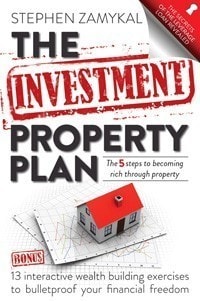
This article is an exerpt from The Property Investment Plan by Stephen Zamykal.
Stephen Zamykal is the director of four award-winning Mortgage Choice franchises, founder of online property investment network Australian Property Club, and author of the new book The Investment Property Plan ($24.95), now available at all good book stores and online at www.australianpropertyclub.com.au