“The civic and cultural heart of Sydney’s East”: Bondi Junction masterplan revealed
Waverley Council has made a call that many councils have been reluctant to make publicly. Growth is coming, regardless of who controls it.
The release of the Bondi Junction Vision and Master Plan is less about whether the Eastern Suburbs’ primary centre will change, and more about how that change is shaped, funded, and ultimately experienced on the ground. Waverley Council has released a 100-page plan which is effectively the first comprehensive blueprint for Bondi Junction in over two decades, and in doing so, signals a clear shift in how councils are positioning themselves in the current planning environment.
For the past 18 months, the conversation across New South Wales has been dominated by the State Government’s Low and Mid-Rise Housing reforms and the emergence of the Housing Delivery Authority pathway. Both have created faster, more centralised avenues for development approvals, particularly in well-located, infrastructure-rich areas like Bondi Junction.
Waverley Council’s response has been to move early, and decisively.
Rather than react to individual proposals as they come through the HDA or broader State-led reforms, Council has sought to establish a clear, place-based framework that sets the terms for how Bondi Junction evolves. The underlying position is relatively straightforward: if densification is inevitable, it should be tied to infrastructure, public domain improvements, and a cohesive vision for the centre, not delivered piecemeal through ad hoc applications.
At its core, the document is attempting to reposition Bondi Junction from what it largely functions as today, a transport interchange anchored by a major retail centre, into something far more layered. The ambition is to transform it into what the plan describes as the “civic and cultural heart of Sydney’s East,” a place that is active beyond commuting hours and capable of supporting a broader mix of uses, experiences and communities.
That repositioning is built around four key ambitions.
The first is to create a true destination. Bondi Junction already attracts significant foot traffic, with more than 86,000 daily transport users and millions of annual retail visits, but much of that activity is transient. People pass through, rather than stay.
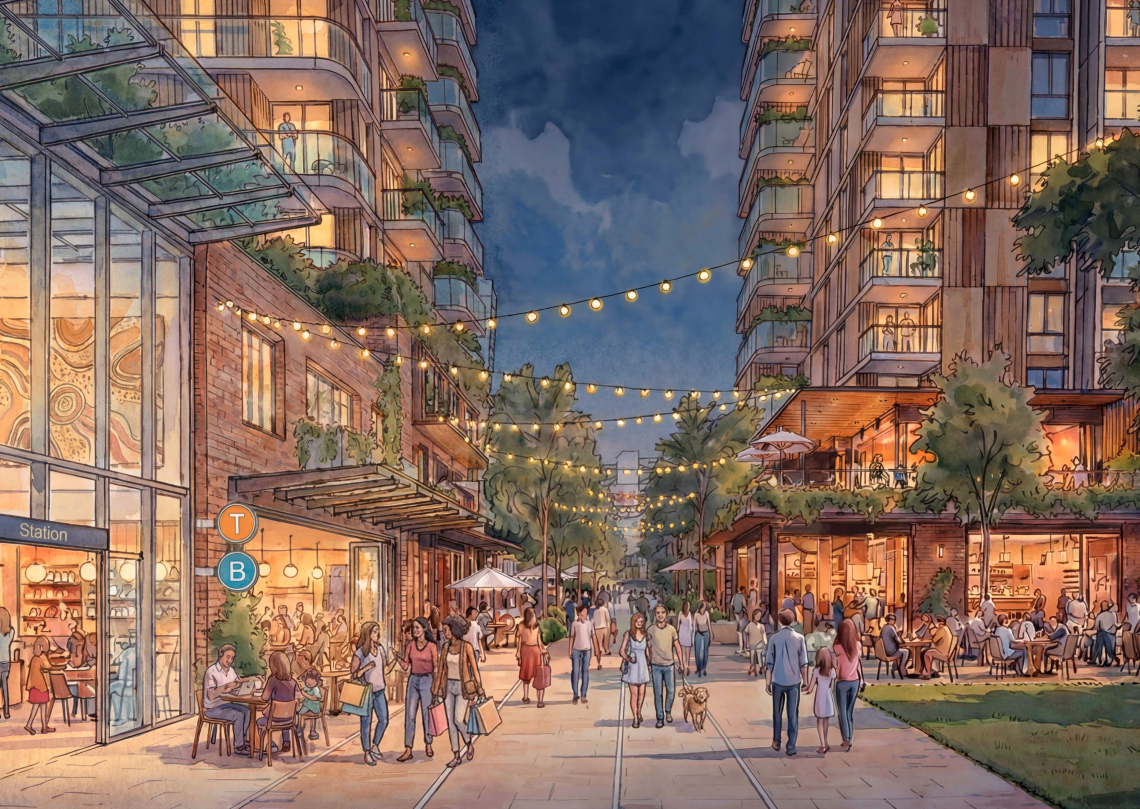
The Master Plan seeks to change that dynamic. It leans heavily into the idea of an “18-hour economy,” extending activity well beyond traditional retail hours through dining, cultural programming, events, and a more active night-time offering. This is not just about adding more hospitality venues, but about fundamentally shifting how the centre operates, from a daytime shopping destination to a place that functions across the full span of the day and into the evening.
Oxford Street Mall sits at the centre of that shift.
Long seen as underperforming relative to its potential, the Mall is identified as one of the key catalyst projects in the plan. It is to be reimagined as a day-to-night spine, combining retail, dining, wellness and cultural uses in a way that creates a continuous flow of activity. Outdoor dining, rooftop venues, laneway activation and a curated events program are all part of the strategy, alongside significant public domain upgrades that aim to improve comfort, safety and usability.
The second ambition is to transform Bondi Junction into a world-class interchange.
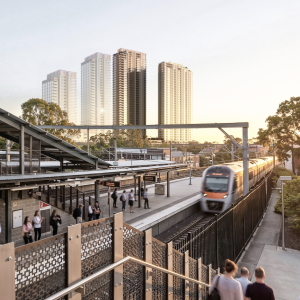
Despite being one of the most heavily used transport nodes in Sydney, the current experience is fragmented. Connections between the station, Westfield, Oxford Street Mall and surrounding streets are often unclear, and major roads create physical barriers that disrupt pedestrian movement.
The Master Plan proposes a more seamless, people-focused network. That includes clearer pedestrian links, improved wayfinding, better integration between transport modes, and a rethinking of how arrival into the centre is experienced. The aim is to shift the perception of Bondi Junction from a place people move through, to a place they arrive in.
The third ambition focuses on greening and open space.
One of the more consistent pieces of community feedback throughout the Vision phase was the need for more greenery, better public spaces, and a more comfortable urban environment. Despite being surrounded by major parks, Bondi Junction itself has relatively limited accessible open space, with much of the public realm dominated by hard surfaces and traffic infrastructure.
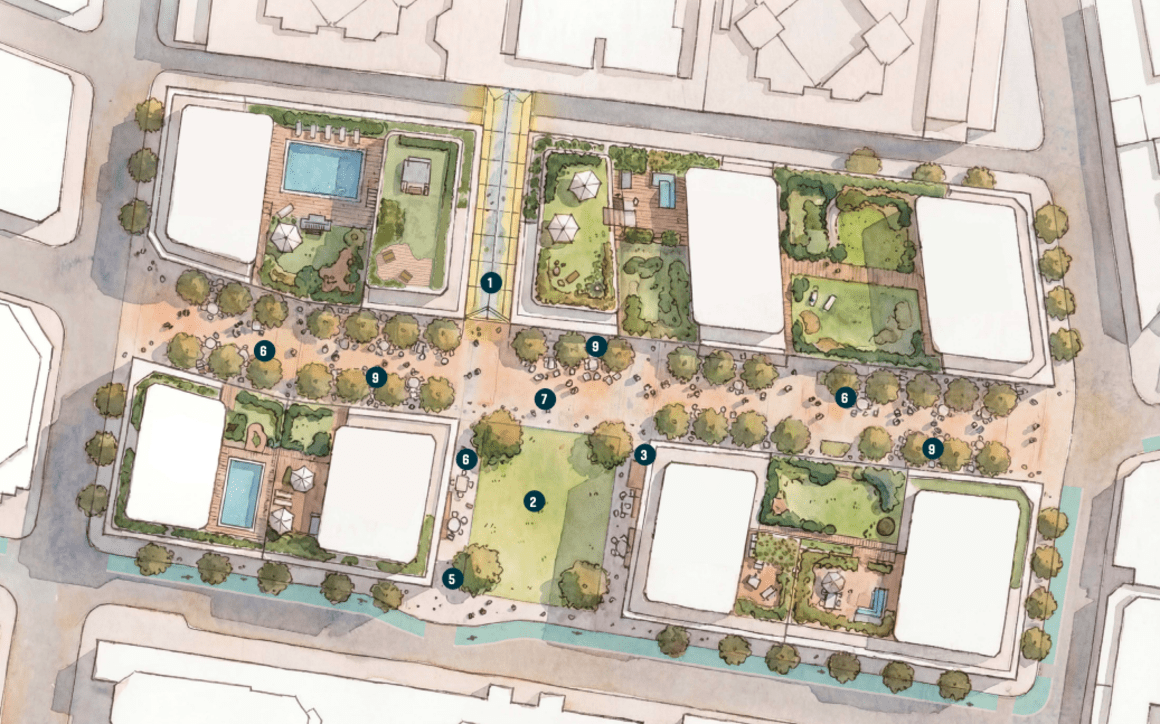
The plan responds with a network of new and upgraded public spaces, increased tree canopy, and what it terms the “Parkline,” a green link connecting Waverley Park through to Centennial Park. This is not just about aesthetics. It is about addressing heat, improving liveability, and ensuring that increased density is matched by access to high-quality outdoor space.
The fourth ambition is perhaps the most important from a development perspective: growth that gives back.
Bondi Junction is already the primary location for new housing supply in the Waverley LGA, and that is expected to continue. The area carries a target of 2,400 new dwellings by 2029, with further growth projected beyond that as demand for well-located housing continues to rise. The Master Plan does not seek to limit that growth. Instead, it attempts to shape it.
New housing is to be concentrated around transport, with stepped building heights designed to protect the character of surrounding neighbourhoods. At the same time, the plan introduces a more explicit link between development uplift and public benefit. This is where value capture becomes central.
The document outlines a framework where increased development potential is tied to contributions that fund public domain improvements, community infrastructure, open space, and affordable housing. It is an approach that recognises that much of the transformation of Bondi Junction will be delivered by the private sector, but seeks to ensure that the benefits of that growth are shared more broadly. The Civic Precinct is a key part of that equation.
Leveraging Council-owned land, the plan proposes a consolidated civic and cultural hub centred around Ebley Street. This would include new community facilities, cultural spaces, and potentially a new Council Chambers, creating a focal point for civic life that currently does not exist in Bondi Junction at scale.
It is one of several catalyst projects identified in the Master Plan, alongside the Oxford Street Mall transformation. These projects are intended to anchor change, acting as early interventions that unlock broader investment across the precinct.
Importantly, the Master Plan is not just a design document. It includes a delivery framework that sets out how these ambitions are intended to be realised.
Council is explicit in acknowledging that it cannot deliver the transformation alone. Implementation will require coordination between State agencies, private developers, landowners and the community, with a mix of planning agreements, infrastructure contributions and direct delivery mechanisms used to fund and stage improvements over time.
The plan outlines a mix of short-term, medium-term and long-term actions, from immediate public domain upgrades and planning controls, through to larger-scale projects that will unfold over the next decade or more. In practical terms, the next 12 to 24 months will be the most important.
This is when the Master Plan will move through exhibition, refinement and eventual adoption. It is also the period in which Council will seek to embed the framework into its planning controls, giving it weight in the assessment of future development applications.
Council officers have indicated that once the Master Plan is in place, it could be used as a benchmark when assessing Housing Delivery Authority proposals, and potentially reduce the need for further HDA declarations within Bondi Junction. In effect, it is an attempt to bring planning control back to the local level, while still aligning with State housing targets.
That tension between State-led reform and local planning control is not unique to Waverley. It is playing out across Sydney.
If delivered as intended, Bondi Junction will become denser, more active, and more complex. It will support more residents, more workers, and a wider range of uses, extending beyond its current retail core into a more layered urban environment.
Joel Robinson
Joel Robinson is the Editor in Chief at Apartments.com.au, where he leads the editorial team and oversees the country’s most comprehensive news coverage dedicated to the off the plan property market. With more than a decade of experience in residential real estate journalism, Joel brings deep insight into Australia’s evolving development landscape.
He holds a degree in Business Management with a major in Journalism from Leeds Beckett University in the UK, and has developed a particular expertise in off the plan apartment space. Joel’s editorial lens spans the full lifecycle of a project, from site acquisition and planning approvals through to new launches, construction completions, and final sell-out, delivering trusted, buyer-focused content that supports informed decision-making across the property journey