QLDWhat’s ahead for South East Queensland’s next development wave: Five minutes with Mosaic’s Brook Monahan
What’s ahead for South East Queensland’s next development wave: Five minutes with Mosaic’s Brook Monahan
Few developers in South East Queensland have shaped the new development apartment market as profoundly, or as consistently, as Mosaic Property Group. In 2025, the business delivered another very strong year across Brisbane, the Gold Coast, and the Sunshine Coast, building on the foundations of nearly two decades of discipline, long-term thinking, and relentless refinement of its craft.
Their continued success is driven from the top. Founder and Managing Director Brook Monahan, very much credits the success to a workforce of “massive grafters”, and a culture where complacency simply doesn’t exist.
“In every part of our business, we’re constantly pushing to get better” Monahan told Apartments.com.au. “We never rest on our laurels.”
The company’s growth continued its upward trajectory, with the developer completing six luxury projects in 2025, representing approximately $850 million in value and delivering 536 new luxury homes. Mosaic also sold over $1.4 billion worth a new luxury apartments at an average price point of $3.41 million in 2025.
Heading into 2026, they have a further five projects under construction and an immediate pipeline across Brisbane and the Gold Coast, representing just shy of $2 billion in value. I spoke with Brook about everything from the evolution of Mosaic’s business to the fundamentals driving the SEQ property market.

A market defined by two forces
The fundamental drivers of SEQ’s housing dynamics in 2025 are straightforward: a generational transfer of wealth on a scale Australia has never seen, and migration numbers that continue to exceed expectations.
“An enormous amount of wealth will move through the next decade,” Monahan explains. “That wave isn’t going anywhere.” Simultaneously, “you can’t run migration at the numbers we’re seeing, while also having a generational shift of wealth from boomers, and not expect demand to remain strong. People move here, they bring money, they want to buy a home and create a future.”
While top-end product in some pockets has softened from the frenzy of 18 months ago, Monahan believes the wave will remain “pretty strong,” especially for developers with brand trust and a long-term track record.
“The $4 million to $10 million segment remains fairly robust, but buyers are much more educated now than they’ve ever been. They have access to information and they’re smart people. They’re generally not willing to trust a new entrant asking $15 million with no track record.”
This heightened consumer discernment, he notes, is reshaping how premium projects are evaluated by developers.
The problem behind the crisis
Despite strong demand, SEQ’s housing market remains severely undersupplied. Brisbane needs around 12,000 new homes per year, yet delivered only 4,000 last year. The Gold Coast requires around 6500 but delivered less than half of that. The backlog is massive.
“We’re probably 54,000 homes short in the next five years in Brisbane alone,” Monahan estimates. “Maybe 100,000 across the whole of Queensland.”
The core issue however isn’t planning.
“The planning environment is actually super supportive right now,” he says. “Approvals aren’t the problem. It’s turning approvals into real supply.”
The gap between development approvals and project starts has widened significantly as construction costs escalate, contractors disappear from the market, and inexperienced developers try, and fail, to bring projects to life.
“A development application (DA) is only part of the equation, it means little without the ability to deliver,” he explains. “Many applicants underestimate the complexity involved. It’s not just about securing a site; you need the right formula and all the right ingredients to make it work. Without that, the end result will fall short of expectations and increase the risk of project failure.
The result is market distortion: sites tied up by entrants who lack experience, capital certainty, construction understanding, or a realistic feasibility model. “It’s not good for the industry,” he says. “You get more and more mooted supply but very little real delivery.”
Construction realities and the coming resource crunch
Beyond development capability, SEQ faces macroeconomic pressures. Over $7 billion must be delivered by late 2031 just for Olympics-related obligations. Add $18 billion in hospital and health infrastructure, and the region faces a “resource drain” Monahan believes will reshape delivery timelines and construction pricing for years.
“It will ultimately be great for SEQ for the next 20 years,” he says. “But it puts enormous pressure on an already chronically undersupplied housing market.”
This pressure will inevitably influence pricing. Double-digit growth cannot continue indefinitely, but Monahan sees no path to meaningfully lower construction costs. “It’s impossible to meet demand at a cheaper price point given labour capability and resource competition,” he says.
“Those who can afford it will keep paying more and the rest are fighting to get a foothold. That’s why the market keeps creeping upward.”
Mosaic’s disciplined blueprint: Only A-Grade, iconic, irreplicable
With a long track record of delivery and in-house construction expertise, Mosaic works backwards from the cost of delivery to determine the right price for a site—a disciplined acquisition model they’ve adhered to from day one.
“We’re never out of the market,” Monahan says. “But we’re extremely disciplined. We don’t buy B+ sites. We won’t buy run-of-the-mill locations. Ever. That’s not our brand and it’s also not economically viable for us in most instances.”
Mosaic’s nine current developments illustrate this discipline:
- Lily and Marella, Broadbeach: Two 30-storey buildings with permanently protected views over parkland, beach and coastline
- Isabel and, Jospehine, Burleigh Heads – all “masterpiece” sites on the Esplanade with enduring view corridors of beach, water and coastline in the heart of Burleigh
- Sophia, Palm Beach- directly on the dunes of the most highly sought after stretch of northern Palm Beach beachfront real estate
- Madeline, Broadbeach – “180 degrees beach, water and coastline views, great walk score”
- The Bedford, Kangaroo Point – a site Mosaic first identified in 2016. Amazing walk score, views and inner city connectivity
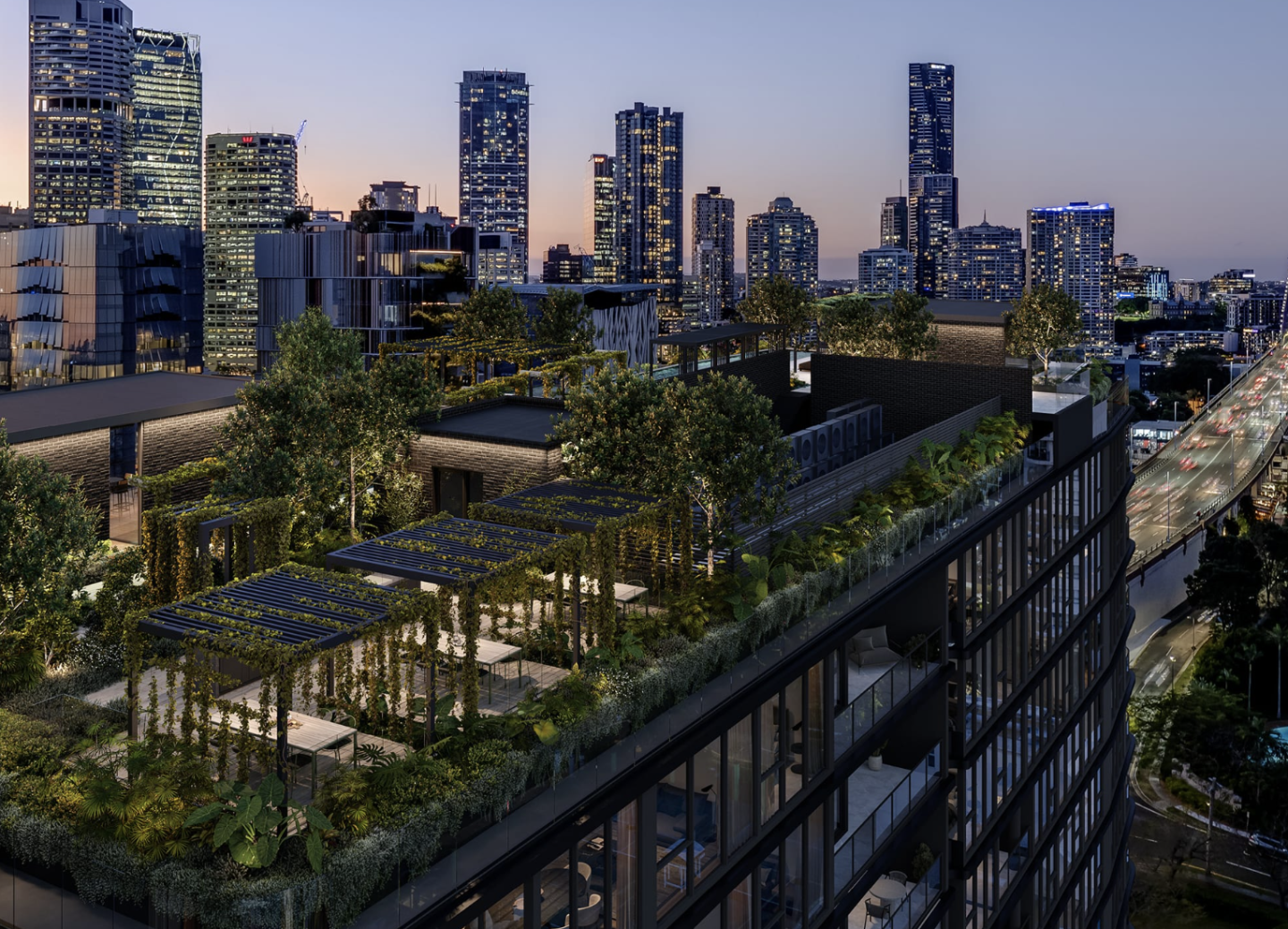
- The Carter, Kangaroo Point – in between the Gabba and the Kangaroo Point peninsula with amazing walk score and uninterrupted and expansive northern city and river views
- South Brisbane (launching 2026) – core inner-city Brisbane river waterfront site on the northern end of the peninsula with amazing river connection and permanent river and city views, amazing walk score
“Nothing we buy is guesswork,” Monahan says. “It’s always an iconic suburb where people genuinely want to live, with strong connections to water, lifestyle, amenity, or permanent view corridors.”
“Mosaic’s two most recent Brisbane acquisitions were several years in the making. The Bedford, launched on the prestigious Kangaroo Point peninsula and achieving 90 per cent sales within months was a site they identified back in 2016. The second, which is the yet to be released at 91 Montague Road in South Brisbane, has been on Mosaic’s radar since 2017.
Arguably one of Brisbane’s last great inner city riverfront sites, it sits within the city’s most dynamic cultural hub, offering unrivalled connectivity, lifestyle, and amenity, and standing as a landmark opportunity to define the next era of riverfront living.
“We know exactly what is and isn’t a Mosaic project. Strategic site selection is the critical foundation of everything we do. We’re always assessing opportunities, but based on our two most recent Brisbane acquisitions, it’s entirely possible that the sites we’re looking at today won’t transact for several years. That discipline is what ensures every project meets our exacting standards.”
The Mosaic engine: Consistency, capability, and relentless execution
What separates Mosaic in a crowded field is not the ability to attract capital or buy a site, but the ability to deliver highly complex high end buildings, whether that is 37 storeys or 18 storeys, repeatedly and consistently.
“These buildings are inherently complex to deliver well,” Monahan says. “It takes a long time to know exactly what the market wants, how to deliver it, how to secure the right contractors and consultants, and how to align the product with what the market is actually willing to pay and can afford.”
With so many contractors exiting the market in recent years, genuine delivery capability has become increasingly rare. Monahan welcomes credible new entrants but cautions that underestimating the complexity of luxury development can lead to poor outcomes.
“It’s easy to assume high-end projects equal high returns, but without the right experience, track record, and capability, it’s a tough road. Attracting capital is one thing—delivering on expectations is another, and when that doesn’t happen, it impacts the entire market.’”
Looking to 2026: A pipeline built on patience and precision
As 2025 draws to a close, Mosaic stands at the strongest point in its history. Since 2012 alone, the company has completed more than $2 billion in projects and is set to deliver another $2 billion worth of developments, hundreds of luxury apartments, all bearing Mosaic’s hallmark of impeccable delivery.
Next to launch are two standout projects: Josephine, an exclusive collection of just 30 half- and full-floor ultra-luxury residences coming soon to the Burleigh Heads beachfront, and a landmark tower on Montague Road in South Brisbane, comprising 204 apartments in the heart of the city’s cultural hub on the banks of the Brisbane river.
“We never arrive. There’s no finish line for us,” said Monahan. “Our focus is on continuing to evolve in the luxury space, creating incredible, design- and lifestyle-led properties that people love living in and that stand the test of time.”
Joel Robinson
Joel Robinson is the Editor in Chief at Apartments.com.au, where he leads the editorial team and oversees the country’s most comprehensive news coverage dedicated to the off the plan property market. With more than a decade of experience in residential real estate journalism, Joel brings deep insight into Australia’s evolving development landscape.
He holds a degree in Business Management with a major in Journalism from Leeds Beckett University in the UK, and has developed a particular expertise in off the plan apartment space. Joel’s editorial lens spans the full lifecycle of a project, from site acquisition and planning approvals through to new launches, construction completions, and final sell-out, delivering trusted, buyer-focused content that supports informed decision-making across the property journey