Interest rate cuts propelling new land sales: Paul Ciprian

Falling consumer sentiment is not expected to affect the recovering market for new homes in Victoria.
A decade of our research shows interest rates were a much larger factor in the health of the market.
In many ways falling consumer confidence and interest rate cuts will add stimulus to the market which will then have a positive impact on new home sales in 2015.
Even though the Westpac-Melbourne Institute Consumer Sentiment Index fell in January the market is expected to continue to surge in 2015 on the back of low interest rates and continued strong migration.
We had the best Christmas period we have had for many years and it doesn't look like slowing down. From our perspective there is no need for a further rate cut.
My concern is that a rate cut in first half of 2015, could risk tipping us back into a boom and bust cycle.
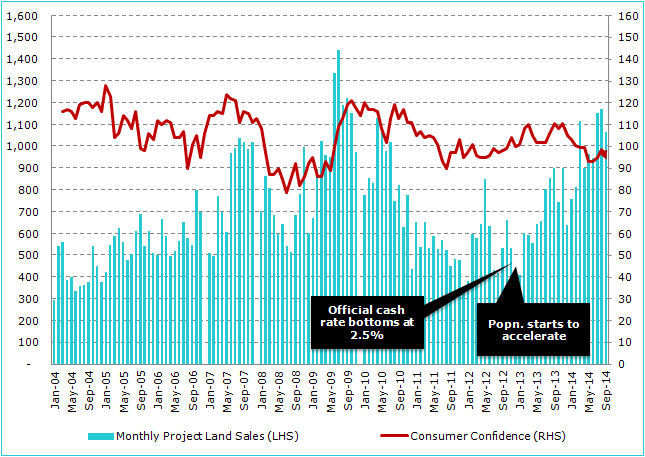
Source: Oliver Hume
The graph above shows that consumer confidence has been falling since September 2013 but land sales for new homes has been growing strongly from just over 600 month (Sept 2013) to more than 1,000 a month in September 2014.
There is a strong link between the record low interest rates in September 2012 with the growth in population that has been propelling the market since sales bottomed around the same period.
The only concern in the economic outlook was Victoria’s unemployment rate that is currently running at 6.8% which could act a break if it continued to rise.
State government figures indicate the Melbourne market will require 161,000 new homes to 2021 with 340,000 new homes to be delivered by 2031 based on state government figures.
There are currently 143 projects across Melbourne’s new communities market with 3,500 blocks actively being marketed.
New land sales are now back to 2009-2010 highs with an average of 1,000 blocks a month sold across Melbourne in the September quarter with a total value of around $600 million.
This is double the sales from the lows of 2011-2012 after the GFC flattened the market and the First Home Buyer Grants stopped.
Housing recovery is being driven by a range of factors including low interest rates and a great perception of value rather than any major government incentives or consumer sentiment.
It has taken three to four years for the first home buyer market to recover and it is now tracking at around 50% of all purchases which is at historic average levels.
I expect the market to continue to perform strongly with Melbourne’s population expected to grow by 90,000 people a year to 2031 with half that from migration.
Paul Ciprian is new communities director with Oliver Hume.