
How Australia Post is solving the parcel problem for apartment living
Australia Post is one of the country’s most trusted institutions, powering one of the largest delivery networks in Australia. As online shopping continues to scale, Australians spent a record $82.6 billion online in 2025, with nearly one in four retail dollars now spent online.
That scale of eCommerce activity has fundamentally changed expectations around how and when parcels arrive, and what happens when someone isn't home.
Problem solved with Parcel Lockers
The traditional alternatives to home delivery are far from ideal. Buildings can rely on reception teams to manage deliveries, which introduces ongoing staffing costs and liability concerns. Parcels can be left in common areas, which creates security and aesthetic issues. Or residents are redirected to nearby Post Offices for collection, which shifts the inconvenience rather than solving it.
The data behind that frustration is significant. Nationally, around 9 per cent of deliveries are carded, meaning the recipient was not home and must collect the parcel from a Post Office. That figure reflects the national average reported between November 2025 and January 2026. In Melbourne, that figure rises to 20 per cent. In high-density living, it climbs again to 28 per cent. In other words, more than one in four deliveries in Melbourne apartment buildings results in a failed first attempt.
How Parcel Lockers work
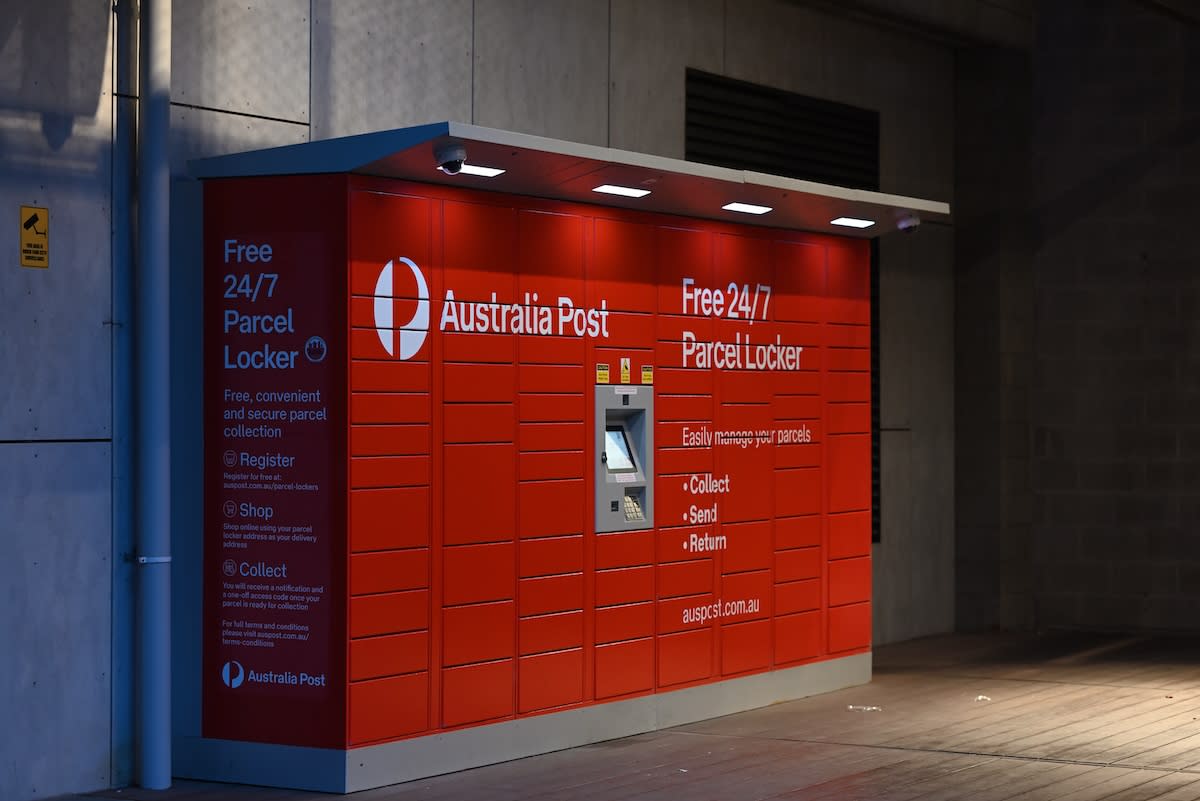
The mechanics are simple. When a parcel arrives, the resident receives a notification either through the Australia Post app or via SMS. They scan a QR code, use their one-time PIN and the compartment opens. The parcel is secure, accessible and removed from the lobby floor.
Located in thoughtfully chosen, easily accessible areas, including external building interfaces, mixed-use precincts or shared communal zones, Parcel Lockers enhance convenience without requiring internal building access or additional operational oversight.
The scale of the network
This expansion represents Australia Post's largest investment in parcel infrastructure to date, building on momentum that began in 2011 when the first 24 Parcel Locker sites were introduced.
Today the Australia Post Parcel Locker network spans over 1,400 locations and more than 105,000 individual compartments, with major investment already underway to significantly expand the network further.
What it means for developers and building operators
A Parcel Locker bank is free to install and free for residents to use. That removes one of the primary barriers to adoption and shifts the conversation from cost to integration.
Australia Post's preference is to engage with developers during the design phase. That allows Parcel Lockers to be located in a considered, publicly accessible space that works for residents and the broader community. Retrofit is possible, and existing buildings can be assessed, but the strongest results occur when Parcel Lockers are treated as part of the core services plan rather than a bolt-on solution.
While the iconic Australia Post red is widely recognised, Parcel Lockers can also be delivered in more muted palettes such as beige or green to align with architectural intent.
For developers, they offer a tech-forward amenity that meets modern expectations, a reduction in courier congestion and building-management load supporting lower emissions and better ESG outcomes, and a meaningful marketability advantage in high-density, eCommerce-active areas, all at no cost for installation and maintenance, with Australia Post funding the program aside from power access.
Who's using them
Generational shopping behaviours show strong, sustained growth across all cohorts. Millennials (27–43) led online spend in 2024, contributing nearly $25 billion. Baby Boomers (60–78) increased their online spend by 17.6 per cent, becoming the fastest-growing adopters. Gen Z (13–26) and Gen X (44–59) continue to lean on delivery services as part of their everyday shopping habits.
Internationally, uptake is even more pronounced. Overseas markets are seeing rapid adoption by both developers and consumers, positioning Parcel Lockers as standard infrastructure in many new residential projects. For Melbourne's development community, this signals a shift in baseline expectations. Just as secure bike storage and dedicated parcel rooms have become more common, integrated Parcel Locker networks may soon be viewed as part of the essential service mix.
The bigger picture
Parcel Lockers aren't just a logistics fix. Developers invest heavily in lobby design, materials, lighting and landscaping to shape first impressions. Yet a stack of unattended parcels can undo that effort in an instant. Embedding parcel infrastructure early allows projects to respond to how people actually live today, supporting resident satisfaction, reducing operational strain and aligning with broader community and ESG outcomes.
As Belinda Quinn, Senior Transaction Manager – Retail & Out of Home at Australia Post, puts it, residents increasingly expect delivery solutions that align with real life, are flexible, secure and available whenever they need them.
Joel Robinson
Joel Robinson is the Editor in Chief at Apartments.com.au, where he leads the editorial team and oversees the country’s most comprehensive news coverage dedicated to the off the plan property market. With more than a decade of experience in residential real estate journalism, Joel brings deep insight into Australia’s evolving development landscape.
He holds a degree in Business Management with a major in Journalism from Leeds Beckett University in the UK, and has developed a particular expertise in off the plan apartment space. Joel’s editorial lens spans the full lifecycle of a project, from site acquisition and planning approvals through to new launches, construction completions, and final sell-out, delivering trusted, buyer-focused content that supports informed decision-making across the property journey


