Paul Keating suggests Barangaroo's new hotel casino be built over the harbour
Barangaroo's new hotel and casino should be built over the water, the former prime minister Paul Keating has urged.
He's suggested Premier Barry O'Farrell reverse the decision for the Barangaroo hotel to be erected on solid ground. Keating is the former chairman of the advisory Barangaroo Design Excellence Review Panel.
But the Premier quickly ruled out the idea of returning the hotel to its original position saying: "I think that would be a terrible precedent given the Harbour is one of the greatest assets and attributes this city has."
The initial 2009 plans under Keating's stewardship had the proposed hotel built over the harbour but it was revised after a public outcry, with Keating yesterday attributing it to "Clover Moore, Darling Island residents and The Sydney Morning Herald".
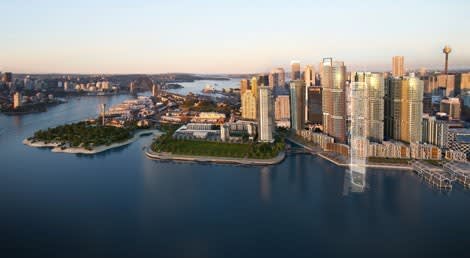
The proposal was derided on unveiling when the SMH published its front-page characterisation of the hotel on the pier as "the worst of Dubai".
It was during the period of anti-development urban affairs reportage by the then urban affairs editor Matthew Moore. It included a six-month campaign against the hotel concept with the president of the Barangaroo Action Group, Ian Campbell, prominent in the reportage. Having paid $9.1 million in 2008, Campbell owned a prestige Sydney Wharf apartment in the nearby Darling Island district, which while over water itself, was at risk of losing morning sun from the then proposed hotel development, which was being presented (below) in as unflattering light as possible.
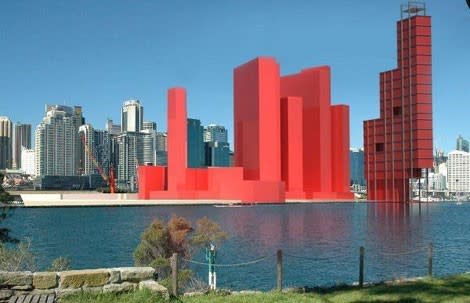
Philip Thalis, who won the initial design competition on redeveloping Barangaroo but failed to secure the design implementation, was the commentator who dubbed the hotel over the harbour as "a catastrophic mistake for Sydney".
"It's the worst of Dubai 'look at me' architecture,'' Thalis told the SMH urban affairs reporting team in late 2009.
Matthew Moore, who has since taken redundancy from Fairfax Media, is expected to appear in an upcoming ABC Australian Story that looks at the emotional upheaval within its dwindling journalistic ranks.
The project's lead architect Lord Richard Rogers did find voice through the property pages of the SMH in May 2011, telling then its property editor Jonathan Chancellor that the hotel was " a wonderful opportunity for a landmark as long as the ground area is public domain".
"It's a visual marker," he told me.
Ivan Harbour, a partner at the London-based architectural firm Rogers Stirk Harbour + Partners – whose design was selected for the project – noted it was the heritage Walsh Bay wharves nearby that helped shape the practice's plan.
"We as outsiders came along and saw that Sydney builds in the water," Harbour said.
"We thought if we can put water into the site through the inlets, maybe we can project outside of the site too. So we are not taking water away, in fact we are increasing the amount of water.
"It seemed to us it wasn't an irrational thing to do to have this as a focal point. We didn't quite understand the comparison with Dubai," Harbour said.
The architects did like its briefly attributed nickname, Big Red.
"We thought fantastic – it has a nickname, which means it's in the consciousness," Harbour said.
The luxury hotel, Sydney's first international premium hotel for more than a decade, was billed as integral to the site's vibrancy, adding activity after hours and at weekends, according to the developer, Lend Lease.
"But then we were asked at some point to make it anaemic," Harbour said.
Among those leading the opposition was the Sydney lord mayor, Clover Moore, who was the subject of a tirade by the former prime minister after she presented to Parliament a petition of more than 11,000 names calling for a review of the proposed development. The attempt to force a special commission of inquiry into the Barangaroo development were colourfully dismissed by Keating as advocacy by ''sandal-wearing, muesli-chewing, bike-riding pedestrians''.
But following the public outcry and the review, the amendments removed the building's obvious redness and also reduced the hotel height from 213 metres to 170 metres.
Its gross floor area was reduced from 44,000 square metres to 33,000 square metres.
"We rather liked its character, as it symbolised a strength," Harbour said. "It hasn't lost its colour, not in our minds. Sydney has a climate for colour – why go grey?"
Rogers agreed. "The colour band in most cities goes from black to white ... it's rather sad."
The decision then led to Barangaroo builders Lend Lease being given a bigger hotel, which requires the city's second casino to fund it, according to today's report by Daily Telegraph reporter Andrew Clennell.
Keating says the compensation was forced because Lend Lease already had a contract with the government to have a hotel on the water and O'Farrell broke that contract.
The Daily Telegraph revealed this week that the government at its next cabinet meeting on November 5 would move James Packer's six-star hotel Barangaroo casino proposal to the next phase of "detailed consideration", effectively giving it the green light.
Labor's shadow cabinet has given the greenlight to the project after lobbying from Packer's camp including the former Labor powerbrokers Mark Arbib and Karl Bitar.
The project's lead architect, Lord Richard Rogers, has described the renewal of the 22-hectare stretch of concrete and East Darling Harbour wharves as ''turning Sydney's back door into another front door''.“The water is critical, the public space is critical, the city is growing and you need more public space,” he suggests.