Estate agents in the eye of Australian economic structural upheaval

The RBA has starkly highlighted a dramatic drop in property sales turnover as a key occurrence when it comes to recent economic structural change.
“In the early 2000s, when the property boom was in full swing and investors were busy buying properties to rent out, around one in 12 dwellings in Australia was changing hands each year,” RBA deputy governor Philip Lowe said.
“Today, the rate of turnover is only about half of this, with around one in 25 dwellings changing hands last year.”
Lowe noted to an AiGroup gathering the lower rate of turnover had contributed to weak employment growth in the real estate sector over recent years.
It had followed “many years of strong growth”.
The data indicated turnover rate was back to 1991 levels.
He suggested it was a consequence of the economy going through an adjustment in household borrowing and spending behaviour.
The RBA has talked frequently about this issue over recent years, and the flow-on effects are evident in various parts of the economy.
Click to enlarge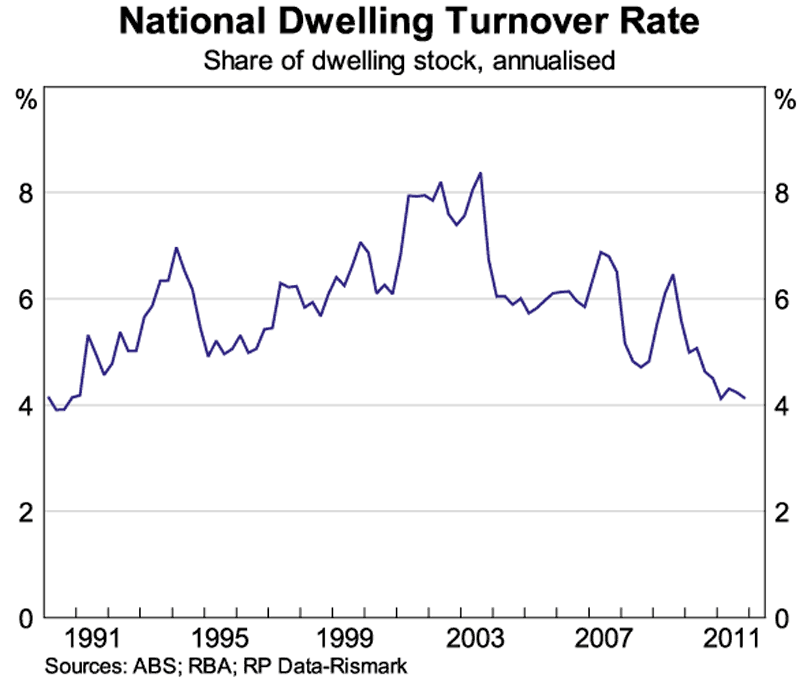
His speech addressed the mining sector boom and positive spill-over effects to a number of areas of the economy, including parts of the services sector.
But he noted the change in household behaviour was also affecting the financial sector in a similar low-growth environment.
“Financial institutions are having to learn to live with much lower growth in their balance sheets than was the case over recent decades,” he said.
“This is leading to changes in business practices, and there has been a slight decline in employment in the banking sector over recent years.
“Conversely, there has been strong growth in employment in the provision of financial advice, partly due to the steady inflows into superannuation funds.”
Another area where the change in household behaviour was having a sizable structural effect was in the retail industry, Lowe said.
“Perhaps the most striking of these is the decline in sales at department stores and clothing and footwear retailers,” Lowe suggested.
“Indeed, since early 2009, the volume of sales in these stores has declined by around 6%. This stands in contrast to relatively steady growth in the volume of sales in the rest of the retail industry.”
He concluded the mining boom had delivered a very substantial increase in Australia's real income and this increase has boosted spending.
But the accompanying high exchange rate is also having a contractionary effect on a number of sectors of the economy.
On the manufacturing industry Lowe noted the sector employed about 950,000 people and accounted for 9% of output.
“This role is, however, changing.
“Realistically, Australia cannot hope to be a large-scale producer of relatively standardised, plain-vanilla, manufactured goods for the world market.”