Bidding farewell to English shabby chic, One Hyde Park paves the way for £10,000 per square foot
Bidding farewell to English shabby chic, One Hyde Park paves the way for £10,000 per square foot
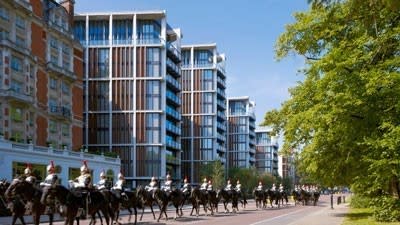
One Hyde Park, the development at the top of Sloane Street, has become London’s most conspicuous residential complex. But as the cracks in the global economy and banking system became chasms after 2008, it seemed possible that it One Hyde Park represented the high watermark of the property market, with several commentators suggesting the development was to the 2008 crash what the Empire State Building and the Petronas Towers were to earlier downturns.
The development’s global influence has been as significant, with James Price, Knight Frank’s head of international residential development, suggesting developers have accepted the need for greater attention to design, specification and services.
“There is a general acceptance that One Hyde Park has raised the bar for development across the world,” Price says.
While planning permission was granted for 86 apartments, the final number is closer to 80 as some purchasers are merging apartments. Spaces of 9,500 square feet (883 square metres) have been created, with penthouses of up to 27,000 square feet (2,508 square metres).
The setting and repeated breaking of global price records has triggered the sale of 62 units for over £1.4 billion.
But Knight Frank residential research analyst Liam Bailey suggests the biggest achievement of One Hyde Park was its impact on the wider London and international markets.
There’s now the expectation that a £10,000 per square foot ($167,624 per square metre) price threshold will be reached by London’s residential developments by 2016, according to Bailey.
His report confirms how values grew during the development of the complex from £4,560 per square foot in 2006 to £7,500 per square foot in late 2011.
The complex, with links to the Mandarin Oriental, was designed by Rogers Stirk Harbour + Partners with interiors by Candy and Candy.
It was reported that one of the Candy brothers, Nick, might become involved in the Goldfields House development in Sydney, but it appears that Valad is going it alone on what is likely to become Sydney's trendsetter.
Bailey forecast there’s unlikely to be another residential development quite like One Hyde Park for some time – partly because of the lack of finance available for speculative residential schemes, and also because super-prime locations like its Sloane Street/Hyde Park site become available only infrequently.
He says in the past decade, as the resale market was squeezed by increasing demand for a London home from the international newly wealthy, the new-build property began to fill the gap.
“Hotel-trained concierge teams, living spaces interior-designed using the best marbles, timber and technology, terraces and off-street parking – all these elements became expected in developments and helped drive prices of the best prime central schemes from £1,000 per square foot in 2000 to £2,000 per square foot in 2004, and up to £3,000 per square foot by 2006,” he suggests.
Knight Frank notes the super-prime development trend is now gathering speed in other centres for the world’s wealthy – New York, Monaco, Singapore and Hong Kong – but only a handful of locations approaching London’s benchmark.
“The new global super-rich do not do stairs and certainly do not ‘get’ the English affection for shabby chic,” Bailey adds.