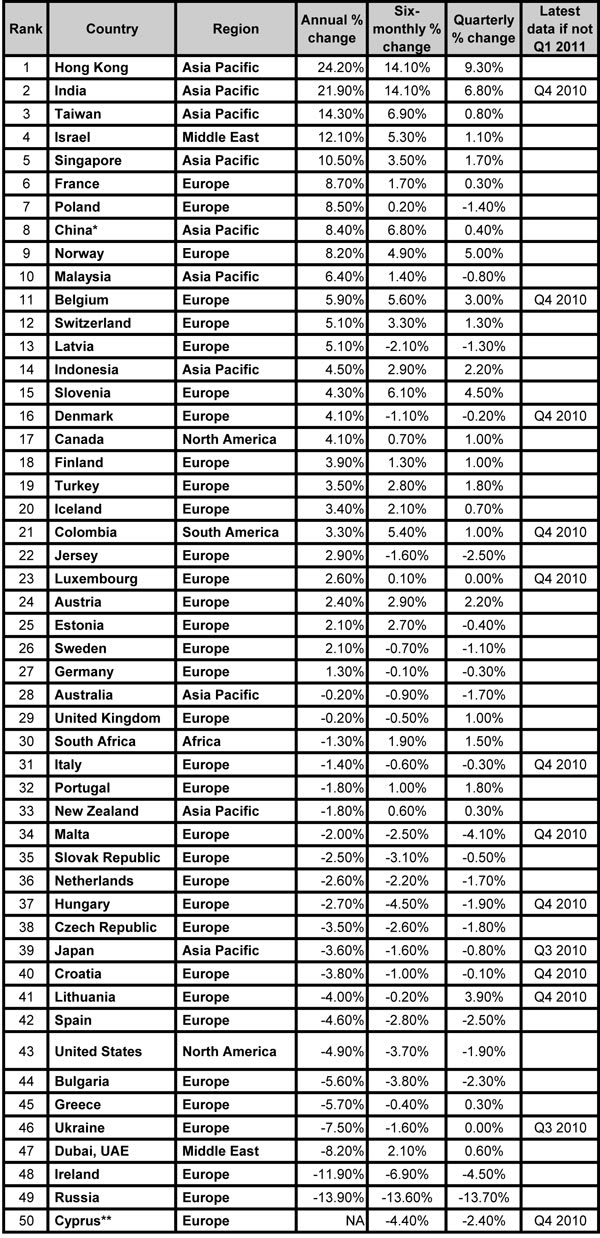
Australia ranks 28th on house price index list

Australia sits among the 25 countries with flat or negative house price growth in the March 2011 quarter, according to the latest Knight Frank Global House Price Index. Knight Frank expects the current slowdown in global housing markets to continue, hitting a low point in the December quarter 2011 based on the assumption that the Asian markets will continue to cool.
A slow recovery in global house prices is tipped for 2012.
Australia ranks 28th on the list of 50 countries, with 1.7% negative growth over the March quarter and -0.2% over the year. Australia was ranked seventh just six months ago.
Asia remains the top-performing continent, recording 8.4% growth over the last 12 months. However, this was down from 17.8% a year earlier.
The weakest region was North America, where values fell 0.4% in the year to the March quarter 2011.
Although house prices in Europe were static in the March quarter, that represents an improvement on 12 months earlier, when house prices on average had fallen 4.1% in the preceding 12 months.
Hong Kong was the strongest-performing country – up 24.2% – followed by India (21.9%) and Taiwan (14.3%).
“Price growth, while not stalling, has faltered in quarter one 2011, pointing to ongoing problems underlying the world’s housing markets,” Liam Bailey, head of residential research at Knight Frank, says.
“In the fourth quarter of 2010 overall annual price growth stood at 3.3%. Three months later this shrank to 1.8%.
“A cursory glance at the results table would suggest it’s business as normal, with Asian countries firmly implanted at the top of the table and both Europe and North America languishing behind,” Bailey says.
“But there are a few less predictable results. House prices in Russia, for example, fell 13.7% in the first three months of this year, positioning it below Ireland in the rankings.
“On the other hand, France has jumped to sixth place in the rankings, up from 30th a year earlier,” he says.
Sweden and Germany, by comparison, have experienced several quarters of positive growth only to fall back in quarter one of 2011.
Bailey says in most of these cases, with the notable exception of Germany, the housing market is reflecting the wider economy’s performance as well as responding to domestic policy decisions.
He notes the efforts on the part of Asian governments to cool house price inflation in the past year have been largely successful, although the latest figures suggest Hong Kong’s housing market is proving less responsive.
“In quarter one of 2010 annual inflation stood at 30.4%; this fell to 25.0% in quarter two 2010 and 22.1% in quarter four 2010 but has now rebounded to 24.2%,” Bailey says.
“Demand from mainland China is a key driver – accounting for nearly one in four Hong Kong property purchases.
“The Chinese market, by comparison, has seen annual price growth fall from 49% in quarter one 2010 to a more sustainable 8.4%.
“Additional measures are being adopted by the Hong Kong Government to curb inflation by launching a new mortgage database,” Bailey says.
“Banks may refuse mortgage applications, lower loan-to-value ratios or offer higher mortgage rates if applicants do not share their mortgage data.
“Such a move is expected to further suppress speculative activity, as speculators tend not to disclose their mortgage histories as it can limit their ability to own multiple flats,” Bailey says.
“In summary, we expect to see the current slowdown in global housing markets to continue, hitting a low point in quarter four 2011 – assuming the Asian markets continue to cool and the government intervention is successful – but with a slow recovery in global house prices taking place in 2012.”